
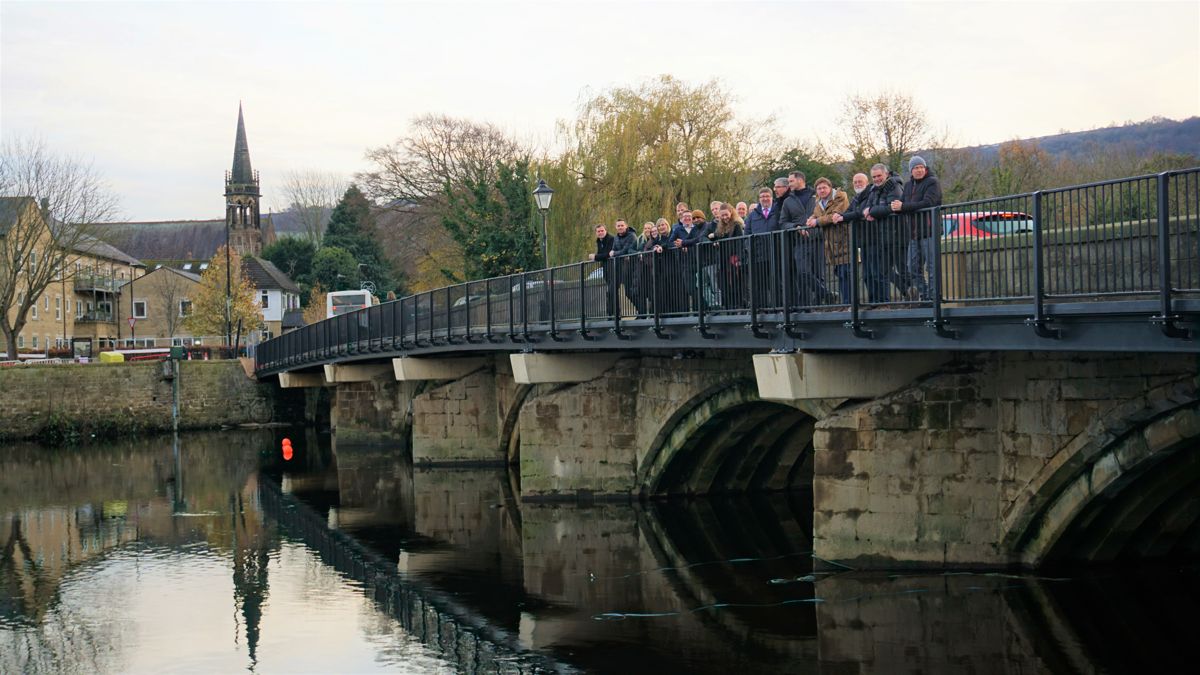
The footway of Otley Bridge in Otley, West Yorkshire, has triumphantly reopened after a major infrastructure upgrade, replacing the old, defective structure with a robust, 79-meter span designed to last 120 years.
This complex undertaking, delivered by Balfour Beatty, involved meticulous engineering, environmental protection, and extensive community collaboration to restore safe and continuous pedestrian access across the River Wharfe.
What improvements were made during the Otley Bridge footway upgrade in Otley, West Yorkshire?
The Otley Bridge footway was completely replaced after significant defects were found. The new 79-metre structure is built for a 120-year lifespan, using durable materials, and restores safe, continuous pedestrian access, while incorporating environmental protections and extensive community consultation.
Background to the Otley Bridge Footway Project
The Otley Bridge serves as a critical pedestrian crossing, linking communities across the River Wharfe in Otley, West Yorkshire. In July 2023, members of the public alerted Leeds City Council to significant defects developing on the existing cantilever footway. Rapid investigations by the council’s highways engineering team revealed extensive deterioration, necessitating immediate action to safeguard users. Safety considerations drove the urgent decision to demolish and completely replace the aging structure.
Leeds City Council responded by launching a comprehensive plan: constructing a temporary crossing, followed by full demolition and replacement of the defective footway. Construction began in March 2025, with works scheduled to minimize disruptions to both road traffic and pedestrian access. By May 2025, the temporary footway was opened, allowing continued connectivity while the main structure underwent reconstruction.
The deteriorating footway had raised concerns for several user groups and local businesses reliant on the bridge. Area residents and shopkeepers expressed relief that authorities prioritized the footway’s upgrade, recognizing the bridge’s vital role in Otley’s daily life and economic wellbeing. The initial closure was handled with swift communication to the public, ensuring awareness and transparency throughout the process.
Engineering and Environmental Challenges
The Otley Bridge project represented a major feat of civil engineering, delivered by the specialist contractor Balfour Beatty. The new footway spans 79 metres and is designed for a minimum lifespan of 120 years. This long-lasting design required advanced engineering techniques and the use of highly durable materials to withstand not only pedestrian loads but also the challenging riverine environment beneath. The replacement structure’s improved robustness addresses both current and future demands for this essential crossing.
Safety and efficiency were at the core of project planning. To reduce disruption, lane and road closures were strategically scheduled outside of peak periods, notably avoiding full weekend closures – a decision that preserved commuter flows and minimized inconvenience for residents. The phased approach included temporary works: the building of a provisional footpath, prompt demolition of the original structure, and careful sequencing to ensure continuous public access where feasible.
The undertaking required intensive coordination with key stakeholders: the Environment Agency (EA) and English Heritage oversaw environmental and historical considerations. As part of the planning process, comprehensive independent surveys were integrated, covering ecological, aquatic, bat, and arboricultural (tree-related) aspects. These assessments ensured the project upheld stringent standards regarding local wildlife habitat, river health, and conservation of natural features.
Stakeholder Collaboration and Community Impact
Councillor Jonathan Pryor, Deputy Leader of Leeds City Council and Executive Member for Economy, Transport, and Sustainable Development, reflected on the project’s complexity: “We are excited to officially reopen the Otley Bridge footway, which can now be enjoyed safely by the public to cross the town. It marks the successful conclusion of a complex and challenging effort to restore a vital link for the community. We would like to thank everyone for their understanding and patience whilst we completed this major upgrade. We also extend our thanks to the project team involved who have worked in some really challenging conditions.”
The project team’s collaboration extended to regional park management and environmental bodies due to the proximity of Tittybottle Park and Wharfemeadows Park. Both parks experienced some disruption, as temporary works encroached on green spaces adjacent to the bridge. However, the council laid out clear restoration plans to return these areas to public use. These plans feature the planting of 13 new trees and the replanting of two mature oaks, which were carefully removed during construction and temporarily stored in a tree nursery to ensure their survival.
Community consultation was also a prominent feature throughout the upgrade, with regular project updates disseminated via local channels and the council’s Connecting Leeds initiative. Public engagement sessions helped address resident questions, emphasizing the importance of accessible infrastructure for all, including individuals with disabilities, cyclists, families, and elderly pedestrians. The bridge’s reopening restores a key element of safe and sustainable transport in Otley.
Project Completion and Restoration Efforts
The final phase of the project now focuses on dismantling the temporary footway and restoring the parkland on either side of the bridge. According to the council’s update, “Following EA agreement, the temporary footbridge removal is programmed for completion before Christmas. The reinstatement of the parks and Garnett’s Field is expected to be restored for public use early next year.” Work crews are coordinating with landscape specialists to recover disturbed parkland, ensuring that access paths, lawns, and riverbank habitats are returned to their pre-construction state.
This restoration work involves more than just cosmetic landscaping. The replanting initiative is a multifaceted effort: new trees planted alongside mature oaks will not only help reestablish local biodiversity but also bolster climate resilience for the parks. The council has stressed the importance of monitoring these plantings in the years ahead, guaranteeing they take root successfully and contribute positively to Otley’s green corridors.
Local feedback regarding the reopening has been overwhelmingly positive, particularly as the restoration of public parks and green spaces is highly anticipated. By scheduling the removal of the temporary footbridge and the completion of restoration works outside of the main usage season, the project minimizes long-term disruption and maximizes accessibility for the community. The successful upgrade of Otley Bridge’s footway demonstrates the council’s ongoing commitment to safe, reliable, and environmentally responsible infrastructure management.
- The Otley Bridge footway in Otley, West Yorkshire, has reopened after a significant infrastructure upgrade, replacing a defective structure with a new 79-meter span designed to last 120 years.
- The project involved complex engineering by Balfour Beatty, incorporating durable materials and environmental protections, to restore safe pedestrian access across the River Wharfe.
- The original footway was found to have extensive deterioration in July 2023, prompting an urgent decision by Leeds City Council to demolish and replace it.
- Key stakeholders like the Environment Agency and English Heritage were involved to oversee environmental and historical considerations, including comprehensive surveys for wildlife and natural features.
- The project included significant community collaboration, regular updates, and plans for park restoration, including planting 13 new trees and replanting two mature oaks.