
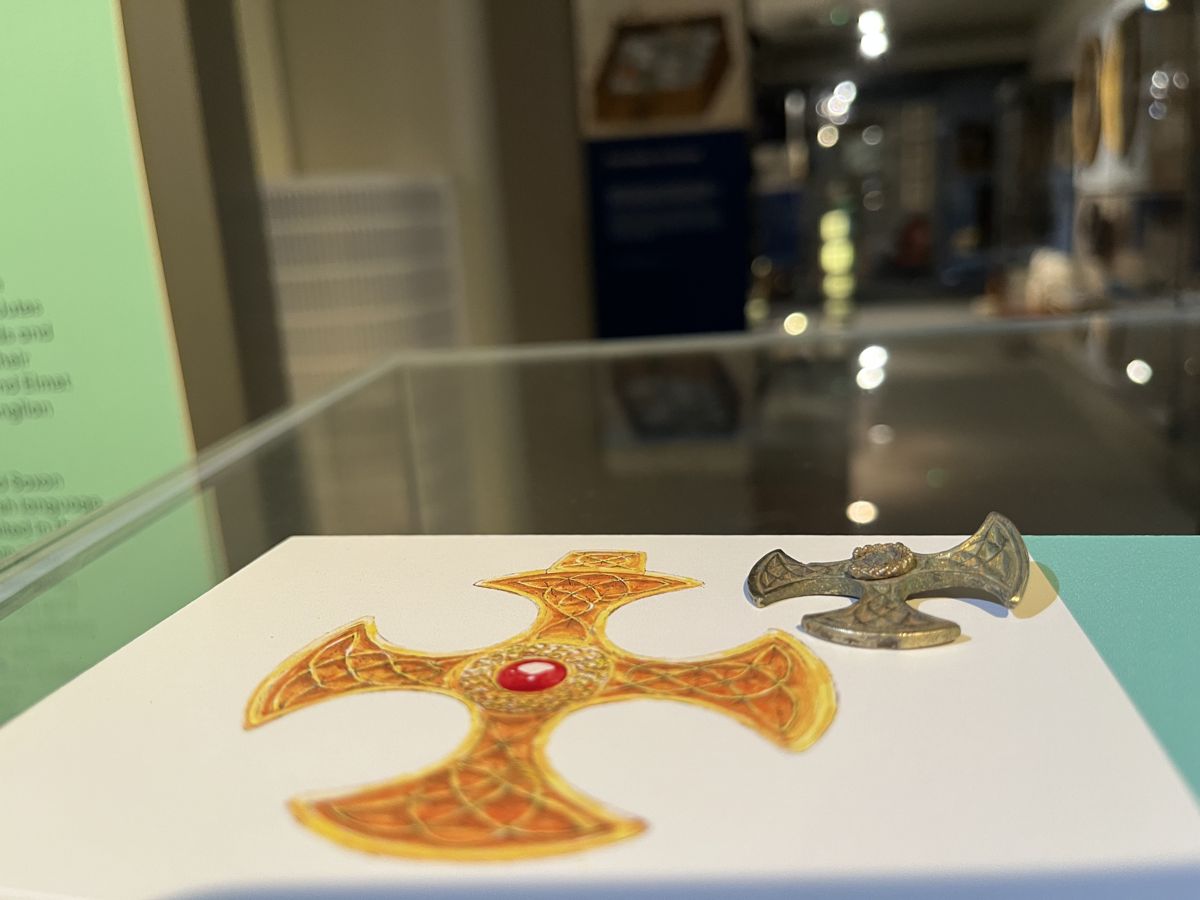
A remarkable Saxon pendant, found by a metal detectorist, is now displayed at the Leeds City Museum, offering a vivid glimpse into Leeds’ significant early medieval past as part of the Kingdom of Northumbria. This ornate gilded silver cross, along with the West Yorkshire Hoard, underscores the city’s rich religious and cultural history, showcasing high-status artifacts and the intricate craftsmanship of the era.
What does the discovery of the Saxon pendant at Leeds City Museum reveal about early medieval Leeds?
The discovery of the Saxon pendant at Leeds City Museum highlights Leeds’ significance during the early medieval period, showcasing its religious and cultural history. This high-status artefact reveals connections to the Saxon Kingdom of Northumbria and enriches our understanding of the city’s past through expert preservation and museum display.
Saxon Discovery: Unearthing an Ancient Treasure
Recent years have witnessed a surge of interest in the early medieval past of Leeds, a city with a history stretching back well beyond the Norman Conquest. This interest has been further ignited by the discovery of a beautiful Saxon pendant, believed to have been worn around the neck of a church official in the eighth century. Located by a metal detectorist, the remarkable cross-shaped pectoral pendant was found with one of its four arms broken and its central stone missing, yet its historical and artistic significance remain intact.
The pendant, now on display for the first time in over 1,200 years, offers both scholars and the public an extraordinary glimpse into the craftsmanship and cultural context of early medieval Leeds. The artefact was processed through the Portable Antiquities Scheme Treasure process, ensuring its preservation and acquisition by the Leeds Museums and Galleries. Its addition to the museum collection was made possible by the support of various funders, reflecting the collaborative effort to safeguard the region’s heritage.
This early medieval pectoral cross, composed of gilded silver and originally adorned with a central garnet, speaks to the city’s role as part of the Saxon Kingdom of Northumbria. The intricate interlacing pattern typical of Saxon decorative art is a hallmark of high-status personal items from the period. Such objects often served as badges of office and clear indicators of religious identity, frequently marking their wearers as figures of authority within the church.
Artistic Reconstruction and Historical Significance
A major draw for museum visitors is the opportunity to view new hand-drawn illustrations, created by archaeological illustrator John Prudhoe, depicting how the pendant might have appeared at its zenith. These vivid illustrations not only capture the gleam of gold leaf and the brilliance of a central garnet but also help the modern viewer visualize the prestige the pendant would have once conveyed.
As Kat Baxter, curator of archaeology for Leeds Museums and Galleries, reflected, “Much of archaeology involves visualising how ancient, often incomplete artefacts might have looked and how they may have once been used. Seeing these beautiful illustrations recreate how this tiny pendant might have looked is a rare, vivid glimpse into the past.” Such reconstructions are essential, especially when objects reach us in a damaged state after centuries underground. They provide both academic insight and public engagement, bridging the gap between discovery and understanding.
The pendant is now exhibited near another remarkable find: The West Yorkshire Hoard. This collection of seven objects, discovered in the Leeds area and acquired by the museum in 2012, dates from the seventh to the eleventh centuries. The hoard includes high-quality jewellery, the kind reserved for individuals of significant wealth and status in Saxon society. The convergence of such finds points to the city’s probable importance during the early medieval period, reinforcing the notion that Leeds was more than a rural outpost during these formative centuries.
Building Leeds’ Early Medieval Picture: Archaeology and Community
Discoveries such as the Saxon pendant and the West Yorkshire Hoard play a critical role in reconstructing the social and religious history of Leeds. While high-status artefacts like the pectoral cross represent the church elite and the wealthy, their survival skews our understanding towards the upper echelons of society. Baxter notes, “Despite its small size, the pendant is a significant find in terms of helping us to build a more complete picture of life in early medieval Leeds, along with other discoveries made locally. Objects representing less wealthy people are less likely to survive, so we do still have a great deal to learn and discover about the local population and how they lived at what was a fascinating period in the history of Leeds.”
This persistent challenge has spurred museums to seek innovative ways to interpret their collections, using artistic reconstructions, digital technology, and community engagement to fill the gaps. Visitors to Leeds City Museum are invited to consider not only the lives of elites but also the stories and experiences of ordinary individuals, whose material culture rarely survives the passage of time. The discoveries suggest continuity in settlement, the adoption and adaptation of Christianity, and the emergence of new social hierarchies.
Community involvement is further encouraged by Leeds City Museum’s status as a “Give What You Can” institution, where visitors are invited to make donations in various forms, including contactless payment and cash. This model helps support ongoing research, conservation, and the development of new exhibitions, making Leeds’ heritage accessible to all. Further information about museum visits and exhibitions is available through the Leeds City Museum website.
The Role of Museums in Preserving Local Heritage
The display of the Saxon pendant and other treasures underscores the vital role that museums play in safeguarding and interpreting historical artefacts. Councillor Salma Arif, executive member for adult social care, active lifestyles and culture at Leeds City Council, emphasizes the importance of accessibility and preservation: “It’s wonderful to see this beautiful discovery on display and to know that a piece of the city’s history that had been buried beneath the soil for more than a thousand years is now available for our visitors to see. Museum collections play such an important role in preserving our local heritage and giving people the chance to discover more about how Leeds became the city we know today.”
Funding for the acquisition and display of such items is often complex, involving a range of support from local and national sources. In the case of the Saxon cross pendant, organizations such as the Arts Council England /V&A Purchase Grant Fund, Friends of Leeds City Museums, and the Leeds Philosophical and Literary Society contributed to making the acquisition possible. The object was formally secured under the framework of The Treasure Act 1996, which governs the discovery and preservation of significant finds in England and Wales.
Through carefully curated exhibitions, educational programming, and public engagement, the museum continues to deepen our collective understanding of early medieval Leeds. The institution’s efforts connect present-day communities with their rich, layered past, fostering a sense of pride and curiosity while ensuring that discoveries such as the Saxon pendant remain at the heart of Leeds’ evolving story.
- A remarkable Saxon pendant, found by a metal detectorist, is now displayed at the Leeds City Museum.
- The pendant is a gilded silver cross, believed to have been worn by a church official in the eighth century.
- It offers an extraordinary glimpse into the craftsmanship and cultural context of early medieval Leeds as part of the Saxon Kingdom of Northumbria.
- The pendant is exhibited near the West Yorkshire Hoard, a collection of high-quality jewelry from the seventh to eleventh centuries, reinforcing Leeds’ importance during the early medieval period.
- Museums like Leeds City Museum play a vital role in safeguarding and interpreting historical artifacts, making local heritage accessible and deepening understanding of the past.